Hey hey, it’s summer.

So after apologizing for not posting many updates of late, I promptly fell off the wagon again and neglected the whole blog thing for another week plus.  In my defense though, this time I’m busy!

In just a few days, I’ll be showing up in a play in Shinjuku in a bit part, the practices and rehearsals for which have taken up a huge amount of my time over the past month.  Spoiler alert, I’m only showing up in one scene.  It’s a fun change-of-pace role but it’s only like five lines and a couple minutes of standing around in the background as things happen with the main characters.

This being Japan, me being in one scene requires me to be present at every single practice, meeting, and rehearsal, even the ones where the scene in question isn’t even brought up.  Being on the lowest tier of the Yoshimoto media conglomerate hierarchy, my primary duty in this place can best be described as a crazy mishmash of stagehand, personal assistant to the executive producer (lots and lots of sprinting to the convenience store to buy random shit), and general punching bag.  You want to be a comedian in Japan?  That’s what you’re gonna have to do.

Once all three performances of the play are done, I have a bunch of other live shows and appearances coming up in the month of July.  Most of them are in Shibuya during the work week.  All of them are in Japanese.

I’ll hopefully also have more exciting information to share with y’all in the coming weeks regarding the release of a certain part two of a certain manzai-centric Netflix show.


Stay tuned and stay in touch.  You can find my live schedule below (along with the poster of my play)! Continue reading

Going through the motions.

The updates and blog posts have been few and far between of late.  Of course, if you’ve been paying any attention whatsoever you already know this.  Life has a funny way of coming back around on you.  One minute you’re convinced that you have enough to say or write to put into words every day and the next you’re sitting around pounding your head into the wall trying to squeeze out a word turd through your prolapsed mental asshole. Continue reading

いるかパンチスケジュール.jpg

February Schedule!

いるかパンチスケジュール.jpg


Contact me on Twitter or here for tickets!

You’re a (Very) Minor Japanese Television “Celebrity”, So Now What?

So we’ve beaten the whole Netflix horse for a while now and talked about introducing a manzai to the world (at least that was the idea) but what about my terrestrial career (i.e. the non-English language media)?

The Japanese new years holiday is one of shuttered shops and clogged transportation networks (interestingly enough, everyone is so busy getting out of Tokyo that the capital becomes an absolute breeze to get around for the week).  It is also, most helpfully for me, a time for people to gather around and watch a shitton of TV.  Almost every single popular program on television will put together a several hour long special show to be shown in the week around New Year’s Day as the Japanese public apparently still hasn’t figured out (a) how to use a DVR, (b) that you can watch almost anything you want on a streaming service, (c) the more time spent watching your favorite personality ham it up on screen means less spending quality time with your loved ones.

Yes, in Japan, on New Year’s, television is still king.  And thanks to the national network’s ravenous need to fill airtime with original “special” programming, this means young struggling comedians such as myself find themselves with increased opportunity to see some airtime. Continue reading

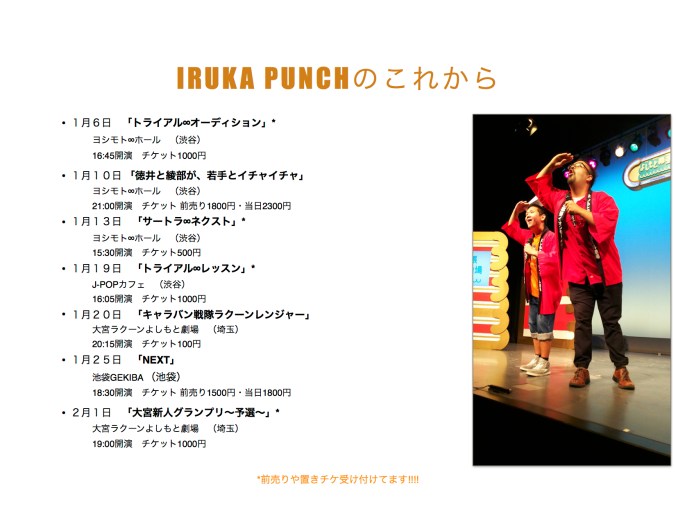
Live schedule to start the year.

いるかパンチスケジュール1月.jpg

Good riddance 2016

And so another year has passed, and a big one at that.

img_7909

2016 was a year of great change, both worldwide and personally. Continue reading

After the Show’s Ended: A Post-Solo Show Postmortem

So it’s done!  Over!  I can finally take a step back and breathe!  After a long month plus of preparation, practice, and figuring out how exactly to fill an entire hour of stage time, Iruka Punch’s first solo live show went off with minimal hitches and nary a tear to be seen.

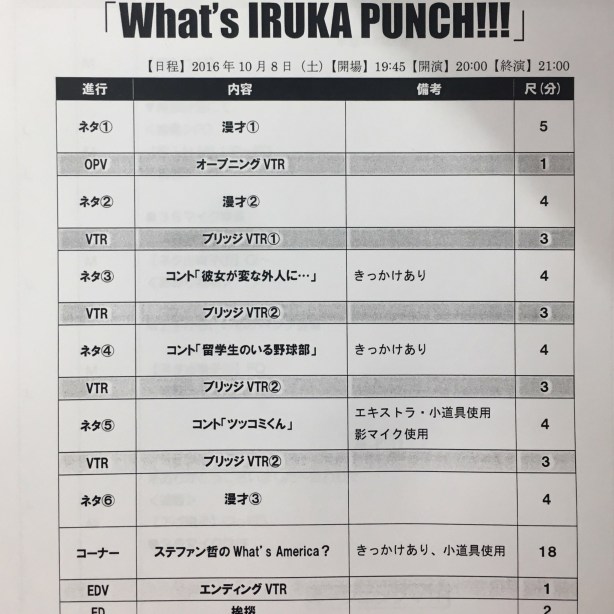
img_7730

Here’s the general order of our show, for those of you who can read Japanese.

The thing you learn the most when doing a solo comedy show in Japan?  Pacing and tempo is everything.  When working as an owarai conbi in Japan, you generally have two different categories of comedy to work with: manzai, Japanese “stand-up” comedy, and conte, a sort of minimalistic take on sketch comedy.  My conbi, Iruka Punch, happens to have a foot in both pools, which makes doing a solo show a bit harder than it would have been if we had just simply have done an hour of manzai. Continue reading

The Dog Days of Summer?/Early Fall?

It is hot.  It’s rather obvious but it’s still hot out.

Here in Japan, most stores switch into autumn gear almost as soon as the clock hits 12 AM on September First despite the fact the weather often fails to make the same sudden transition to cool nights and fair days.  Really, the only difference here between the “late summer” (August) and the “early autumn” (September) is all the typhoons that conveniently decided to strike the Japanese mainland this month rather than the last.  What the hell’s up with that?  (That’s a rhetorical question, you humorless meteorologist.  I don’t need an actual explanation regarding high and low pressure systems.) Continue reading

Japanese Comedy: An Introduction

So it’s almost been an entire year since I made the rather impulsive decision to uproot my (nominally) cushy life, quit my easy-to-do English teaching job, and moved to Tokyo to pursue a career in Japanese comedy.

As it turned out, joining the Japanese geinoukai (“entertainment world”) was both as simple as one, two, three and much much more complex than I anticipated.

untitled

The main thing you need to understand about the Japanese entertainment system is that the agency rules all.  Whereas the wide-ranging perception of the western entertainment world is that of the managers and agents working for the talent, the reverse can be said of the Japanese system.

To get into the Japanese entertainment world, you need to get into a company.  And to get into a company, you need to go to school.  And so, go to school I did, a twenty four-old college graduate white dude in a world mostly unknown to the unwashed gaijin hordes (Take that, dude who just posted the five-thousandth weird-Japanese-ice-cream flavor reaction video on Youtube.)

I’ll possibly get into the different companies of the Japanese entertainment world somewhere down the line but for now, I’ll just tell you that I am on track to become a part of Japan’s largest comedy company by the end of the month after an arduous grind of a year at Tokyo NSC, Yoshimoto Kogyo’s school for aspiring comedians, wannabes, and people who have absolutely nothing better to do and drop out after three months (this constitutes a large chunk of the entering class every year).  It’s been a slog, some parts fun, a lot of parts varying degrees of infuriating and boring, but its almost done and I finally, FINALLY, find myself in a position where I’m allowed to talk about the stuff I’ve done, seen, and learned.

So here we are, tired, sick, with feet cold and wet from the rain.  What better time to start talking comedy.

Comedy in Japan

Japanese comedy has some similar traits to the American comedy that I grew up with and loved.  It also has inherently different traits of its own, the biggest being a general emphasis on small teams, opposed to the inherent “aloneness” of the Western stand-up comedian, which I guess makes sense, considering Japan’s inherent emphasis on team building and group harmony (Blatant stereotype alert!).  Sure there are solo acts but, for the most part, the comedians you see hosting TV shows, slumming it on stage, or bumming around train stations looking for loose change are doing it in pairs (known in Japan as owarai konbi).

In today’s modern Japanese comedy world, acts can roughly be broken up into three different categories.

Pin (ピン)

The broadest of the three categories, this category of Japanese stage comedy can simply be summed up as doing things on your own, be it traditional Japanese stand-up (or, more accurately, kneel-down) known as rakugo or doing things on stage in character or, and I kid you not this is sorta a thing, dancing around in a man-thong whilst doing poses that make you look naked.  Broad comedy, right?  I could get into the different kinds and styles of pin comedy but there’s a bit of overlap and by the time I’d finished explaining things, you’d all probably be bored out of your minds so let’s leave the nitty gritty off for another day.

Conte (コント)

Possibly the form of Japanese comedy most recognizable to people abroad, Japanese conte comedy has much in comedy with the sketch comedy of shows like SNL or half the shows being shown on Comedy Central when it’s not re-airing episodes of Scrubs that nobody watches (Sorry, Zach Braff).  In this form, the starring conbi or group in question gets their acting on to deliver a short scene of some comedic merit.  The audience, generally finding what they are seeing humorous to some degree, laughs, which is the action of exerting air through your windpipes in a manner that produces noise.

Really anyone who’s seen a episode of Saturday Night Live knows what a sketch is and if you don’t, well shame on you.

Manzai (漫才)

Two dudes (or three… or dudettes) and a mic.  Since I’ve come to be a part of the Japanese entertainment world, many a person has tried their damned hardest to convince me this is a style of comedy unique to Japan.  But as I see it, it’s unfortunately not.

Having much in common with vaudeville acts of old, manzai as it is commonly performed is a conversation between the boke (idiot) and the tsukkomi (straight man).  As a system of delivering jokes, it’s really fool proof and timeless and acts like Abbot and Costello or Laurel and Hardy have shown us.

There is a certain slapstick element to the thing that can be a little hard for Westerners to swallow at first (along with the usual “cultural differences” problem that can make humor a little hard to go over for the foreign eye) but manzai can also be incredibly funny and is, more importantly, perhaps the most popular form of comedy in Japan, with countless theaters across Japan holding several manzai shows a day.

It is on this form of Japanese comedy that I will first focus.