3/11: Three Years Later (A Newcomer’s View: The Meaning of 頑張る)

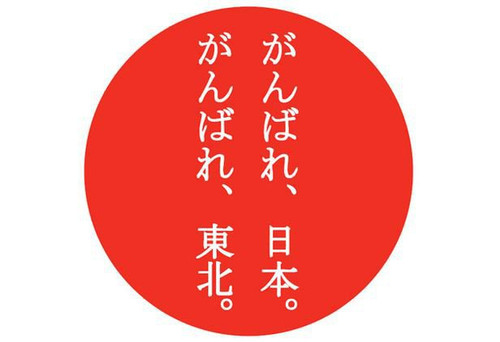
The rallying cry of an entire nation

The rallying cry of an entire nation

Three years ago around this time, the lives of millions of people living along the entire northeastern side of Japan changed forever.  Only a few kilometers east of where I sit today, tsunami waves ravaged coastal communities, obliterating centuries worth of traditions and family businesses in the blink of an eye.  Several dozen kilometers north of me, the Fukushima Daiichi Nuclear Plant would also be hit by massive waves that reached a reported 133 feet high in some areas, setting off a chain of events that have removed thousands of people from their long-standing homes in its radius.  Even today, more than 267,000 people remain displaced by the events of March 11th, 2011, many residents of communities that no longer exist after being swallowed whole by the churning arms of the angry sea.

Living where I do, between the greater Tokyo community and Tohoku, I am placed in the interesting position of being in a place that was spared of much of the earthquake’s wrath but one that has still suffered much of its psychological damage, affected by the disaster nevertheless.  One of my co-workers is originally from Fukushima but moved for the sake of his young family following the aftermath of the nuclear disaster.  But a short train ride away, the coastal port town of Oarai is struggling to return to normal after being hit by the tsunami (though it was further down the coast than the hardest hit areas,  the town was still hit with a considerable amount of water).  Many of you may have seen images of a whirlpool in a harbor from that day.  That harbor was Oarai.
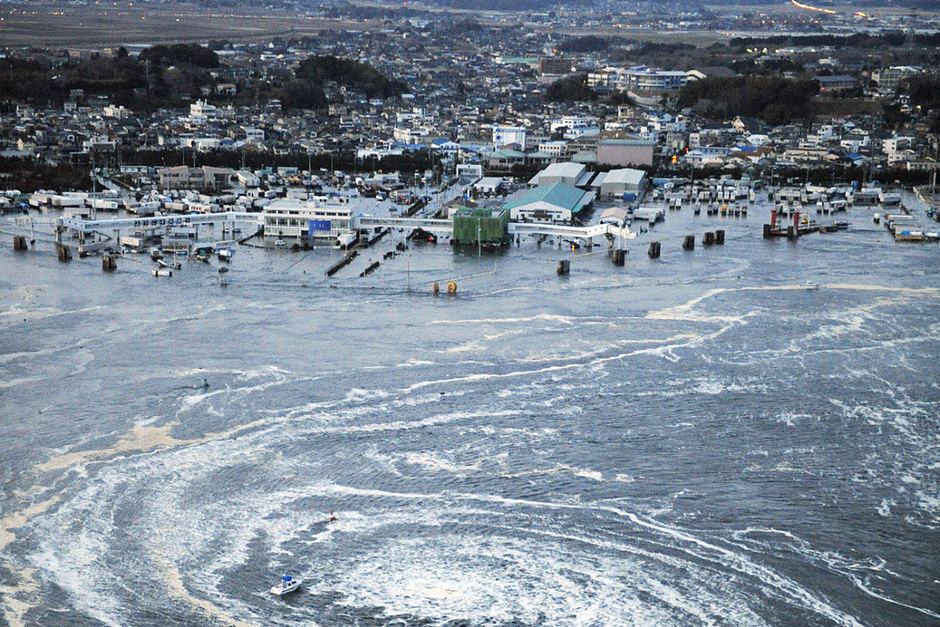
Oarai, Ibaraki Prefecture shortly after being hit by the March 11th tsunami. (photo credit: Kyodo)

Oarai, Ibaraki Prefecture shortly after being hit by the March 11th tsunami. (photo credit: Kyodo)

But only an one hour train ride away is Fukushima prefecture, a name that has now become synonymous with nuclear disasters and radiation leaks but was even ravaged more by waves of biblical proportions that ripped out the hearts of entire communities with unwavering cruelty.  The train line that once ran from Tokyo, through Mito and Fukushima, to Sendai in the heart of the northeast now effectively stops at the border between Ibaraki and Fukushima, the tracks from that point on either washed away or smack-dab in the middle of a nuclear exclusion zone.
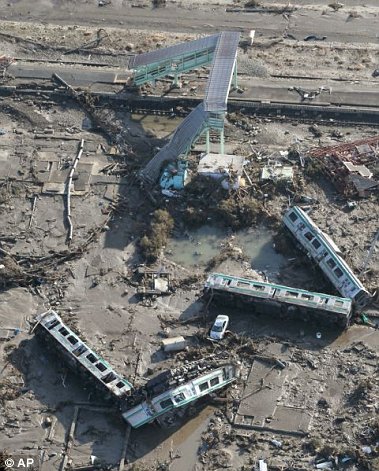
I ride this train ever week just about an hour from where this picture was taken.

I ride this train ever week just about an hour from where this picture was taken. (Kyodo)

Almost everywhere I look, I can see banners, signs, flyers, ads, streamers all sporting the same message: 「がんばっぺ茨城」 (ganbappe Ibaraki).  がんばっぺ, or it’s more common form がんばれ, is an interesting phrase in that while there are various ways people can translate it into English, there’s really no term in English that really comes close to capture it’s meaning.  I’ve seen がんばれ translated as “fight” (Keep fighting, Ibaraki!), “keep at it”, “do your best”, and various other forward momentum terms for putting 120% of one’s effort into doing something but none of them really seem to come close to the Japanese word, no matter how many syntactic hoops one jumps through.  So I could try to tell people in Tohoku, Ibaraki, and all of Japan to keep on fighting and to keep on keeping on, but, at the end of the day, がんばれ is all that needs to be said.  And that’s the mentality here and all across the northeastern portion of Japan I now seem to call home.  Something terrible happened but there’s nothing to do but keep がんばれ-ing until those terrible days have somehow vanished from the land.

People don’t seem to smile here as much as they should.  And after what they’ve had to go through, who can blame them?  In many ways, the March 11th earthquake signified the end of a way of life for the people of Tohoku.  While most of the international media world has decidedly turned its eye from the plight of the survivors of the earthquake save for the occasional nuclear meltdown fear-mongering, people are still struggling to this day.  Over 11,000 people were killed that day, thousands more still missing.  The number of stress-related deaths attributed to 3/11 has increased year by year.  Over 267,000 people remain refugees, countless more have been forced to move away from the long-time familial homelands.  Entire cities remain empty or washed away in the North, many never to be populated again.  It’s all enough to make someone’s head spin.  Millions of lives changed forever in the blink of an eye.  Think about that next time you complain because you can’t find a parking spot at Walmart or you have to wait ten minutes in line before you can order your triple-milk soy latte from Starbucks.

Having moved here only four months ago, I did not have to experience those terrible days after the earthquake and tsunami, the uncertainty of the fates of those that I love, the despair when someone dear never came home, the ache of a hometown lost, never to return again.  The worst thing that almost happened to my hometown was our basketball team leaving.  In other words, I will never be able to comprehend the events that continue to rock Tohoku.  I can’t relate to their sadness so all I can try to do is make them smile.  A foolish sentiment maybe, but one that increasingly drives me forward.  I want to see people laugh.  I want people to forget the troubles of their life if only for one fleeting moment.

Today is a day to be thankful for the lives that we do have, to be thankful that our loved ones are safe and sound, to be thankful for the roofs over our heads, the clothes on our back, the times we laugh when something funny happens.  Today is a day to remind ourselves of those people who unfortunately cannot do the same, a day to keep the victims of one of the worst natural disasters the world has ever seen in our hearts.  Today is a day to remember to take a page out of the Tohoku playbook.  When things are rough, when times are dark, grit your teeth, tighten your belt, lace up your work boots, and がんばれ like it’s the last thing you’ll ever do.  Maybe you’ll even learn something in the process.
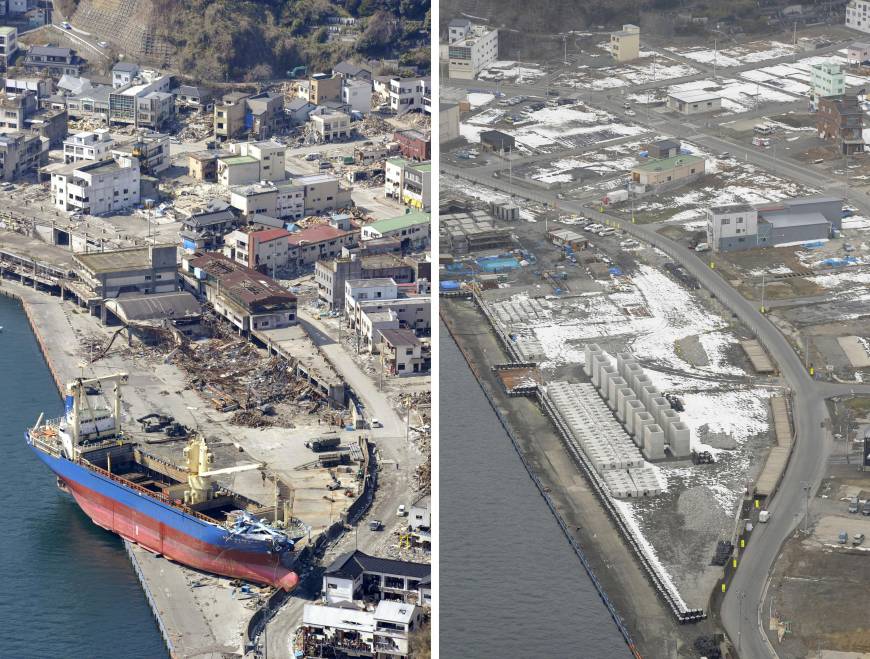
Kamiashi in Iwate-ken in 2011 and 2014

Kamiashi in Iwate Prefecture in 2011 and 2014 (Kyodo)

Oh hey, I have a blog still.

Howdy do, folks.  Sorry for the complete and utter lack of updates and posts over the past couple of weeks, work’s been busier for reasons that I don’t really want to get into, I’ve gone through a weird bit of soul-searching and all that jazz, and honestly I haven’t really found there to be anything that I really have wanted to write about for a while.

It’s been a cold year.  On Friday, I went down to Tokyo to meet up with some friends (more specifically the founders and operators) from my days working at SCOA and promptly got snowed on.  According to the news, this is a once in thirty year thing since the middle of March is typically spring flower blossom viewing season.  With temperatures that usually go below freezing at night, I’m fairly certain that the Japanese climate just hates me and wants me to leave.  Feh.  Good luck with that, buddy.

Life’s been good here in Japan.  Aside from an unfortunate apartment key incident (something that I will go into in greater detail at a later date), it’s been relatively smooth sailing.  Sure there’s no Mexican food here and my utility bills are astronomical but when those are your biggest issues in life, you really have no room to complain.

Anyways, life’s been good to me so far but that doesn’t ever really stop someone from striving for something more.  I like my job (aside from the hours and the typical stuff that comes up in one of these contract English instructor jobs) but I don’t really want to be doing this forever.  So I’ve been looking at other avenues.  I’m a performer, a storyteller… okay, maybe just an attention whore, at heart.  I love entertaining people.  I also like being weird.  And maybe that’s about as deep into the subject as I’m going to get for now.  Maybe I missed all the deadlines this year but 2015 lies ahead.  There’s no use in never trying.  Things may end up being more uncomfortable for me but weird hours, corporate teaching, and 250,000 yen a month (minus pension, health insurance costs [Thanks Japanese Obama], and company union fees, so really 200,00 yen a month) isn’t my ultimate end goal.

Everything I do from now on is going to be in anticipation of the next year.  I need to improve my Japanese speaking ability (I’m good enough to talk to a locksmith but I want more), I need to stop relying on my dictionary for every other kanji I don’t know how to read.  I need to improve my sleep schedule.  And most of all, I need to starting being a creator once again.

Sorry if this is all sounding a bit cryptic but one never knows who might be reading these things.

Now that I’m all settled into my life in Japan, complacency must be avoided at all costs.  I think I have  a goal now, just gotta start running the race.

Anyways, find me on all the usual avenues: Twitter, Youtube, Japanese Twitter, Japanese Youtube, Instagram, all that jazz.  I’m pretty bored at work most of the time so I’ll probably reverse stalk you in return.

-Stephen

Stephen Eats Weird(ish) Japan: Mountain Dew Cheetos

Got a doozy for you guys tonight.  If you’re like me and have lived the typical life of a 18-24 year old American, you have revelled in many a night of eating way unhealthily and generally being up to absolutely no good.  In other words, there were many Cheetos and Mountain Dew type nights.  Well, in that case, I’ve got great/terrible news for you:  In Japan, some genius marketing department has decided to combine the two into one gloriously disturbing package.

Image

Behold, the chalice of misery

Me being the nice guy that I am, I decided to take one for the team and sample this strange exotic delicacy.  The result will not surprise anyone with any rational thinking skills:

It was absolutely disgusting, plain and simple.  While texturally Cheetos-y, the flavor of the corn puffs simply screamed “chemical disaster!”  I’d imagine that the genesis of this latest Japanese masterpiece was that one day a janitor at the Frito-Lays plant accidentally dumped his mop water into a vat of otherwise normal Cheetos and thus forced an entire nation to endure a simply dreadful snacking experience.

On the Mount Rushmore of arbitrary Japanese ingenuity, Mountain Dew Cheetos go up next to kendamas, washlets, and robot dogs.  The Mount Rushmore of arbitrary Japanese ingenuity would then promptly implode, leaving nothing but odd vaguely Mountain Dew-ey Cheetos dust in its wake.

If you encounter a cup of these things in a dark alley, I’d suggest that you run.  Run as fast as your stubby legs can take you.  And don’t look back.

-STEPHEN


Living in Japan: Do you have your papers?

So I’ve been living in Japan for a good while now so I think that it’s safe to say that if America is becoming a paperless society, then Japan is probably a society with some long standing vendetta against trees. In the past four months, I have been presented with more miscellaneous forms, files, official documents, and records than in the rest of my life combined. Rest assured, if you do anything in Japan, there’s probably some sort of form for it in a random office somewhere.

Yes, Japan is meticulously organized. But sometimes there is such a thing as being too organized. Now obviously a lot of the papers in my situation have to do with the fact that I’m a twenty-two year old Japanese citizen who pretty much blipped back onto the Japanese radar after twenty years of living abroad. That said, I have heard horror stories from both gaijin (foreigners) and Japanese citizens alike about the struggles of completing the requisite papers needed to set up a life in Japan.

Now my Japanese reading skills are far from perfect but the Japanese used on these documents is usually (a) very official (read: confusing) and (b) filled with kanji combinations and characters heretofore unused in modern Japan unless your job is reading these forms. When you open up an envelope and see a solid string of ten elaborate Chinese characters typed across the top in bold letters, you know you’re in for a fun night.

So if you’re interested in living in Japan, just beware the papers. I know Kafka was writing about German bureaucracy but I’m pretty sure he meant Japan. So brush up on those oft unused kanji. Or marry a Japanese person the second you get off the plane. Either way, have fun.

-Stephen

20140217-132938.jpg

A baby almost died at work today… So you want to teach English in Japan.

So I had perhaps the craziest experience at work today in which I came pretty darn close to seeing an eight-month-old baby die in front of my eyes.  I’m still pretty darn shaken up by the whole thing so I don’t think I’m really going to be able to write about it for a while.  Earlier tonight, however, I did record a stream of consciousness video about the jarring experience. (Note:  I may have dropped an F-bomb or two in the course of telling my story, so watch out.)

I’m not sure how common it is for couples to bring their infants in to English class in Japan but I’m hoping that I won’t have to deal with another choking baby in my class every again.  Seriously, I’m going to have sweaty nightmares about this day until the day I die or until Alzheimer’s blissfully erases the memory from my cerebrum.  Either way, this is going to stick with me for the rest of my life like the stench of poo in the hiking boots I accidentally crapped in on one of my boy scout trips years back.

What struck me the most is how casual the parents were about it.  If that were my kid, I would be crapping my pants and just generally freaking the fugg out.  Are they better people than me or worse than me?  I dunno.

So in conclusion, plastic kills babies, no matter how cute the kid is.

Stephen Eats Weird(ish) Japan: Special Valentine’s Day Edition!

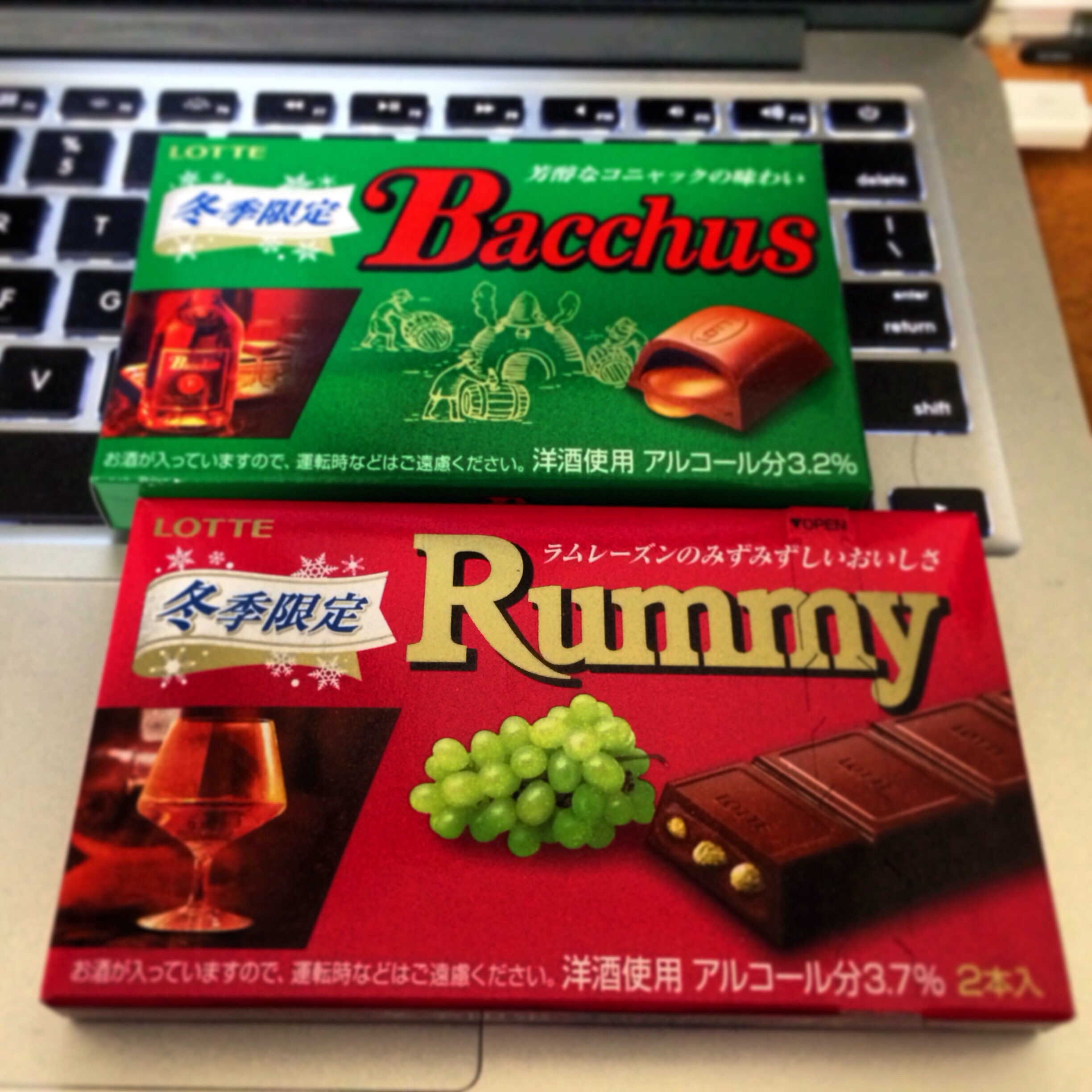
It’s another stormy, cold day in Mito, which of course means I’m spending all my time indoors.  Additionally, it happens to be Valentine’s Day, something which I usually just ignore.  But fret not, the conditions were perfect for a special Valentine’s Day Edition of Stephen Eats Weird(ish) Japan.  Dashing into my nearest convenience store (pretty sure I deserve some sort of frequent buyer discount considering all the stuff I buy from them), I scoured the sweets aisle for something interesting to eat that is also somewhat related to the choclatiest holiday of the year and found these two beauts.

booze chocos

Two different kinds of chocolate with alcohol contained inside them without any sort of marker denoting that fact (in other words, “Hey kids, wanna get drunk?”).  I’m pretty sure Americans would lose their poo if that were the case in US convenience stores.    One caveat/ potential kid deterrent is the price point.  At 300 yen, the chocolates cost roughly 200 yen (2 dollars) more than your typical bar of convenience store chocolate, probably because of the booze, though you couldn’t tell from the taste.

So in order to make the video taste test more palatable (pun intended) for the casual Youtube viewer, I have split the Valentine’s Special into two exciting parts.

In the first part, I test out the Rummy chocolate, containing, you guessed it, rum soaked raisins in a relatively normal bar of chocolate.  Sounds alright right?  Watch to see what I thought of it:


Then, in the second part, I tried out the green Bacchus bar, containing what was supposedly cognac but really tasted more like rubbing alcohol mixed with hand sanitizer.  The chocolate itself was alright if not more heat resistant than normal chocolate in order to keep the liquid alcohol encased inside.


So overall, the Rummy beat out the Bacchus in the booze chocolate Olympics.  If you’re in Japan and in a relationship with an alcoholic, you finally have a chocolate to get him.  Then again, Valentine’s Day is over in half an hour so you should probably get right on that or just buy some to give next year.  If you want to tell your significant other you’re breaking up with him or her, then the Bacchus chocolate is for you.  Nothing says “This relationship is over” more than chocolate with rubbing alcohol inside it.  That said, I can’t seem to stop eating it even though it’s probably burning a hole in my stomach.

With that, I wish you all a Happy Valentine’s Day and I hope all you chicks are getting your loves chocolate like any self-respecting Japanese girl.  (I could get started on the intricacies of Japanese Valentine’s Day but that’s practically an entire book’s worth of stuff.)  Anyways, feel free to contact me through the comments section either here or on YouTube or hit me up on Twitter.  I’m pretty bored most of the time so I’ll probably get back to you about a second after you post, maybe even a second before if it’s a real slow day.

Happy headhunting!

-STEPHEN

Boozy Japanese Chocolates! アルコール入りチョコ

Ate an entire bag of hangover cure corn things in preparation for tonight’s Weird(ish) Food: boozy chocolates!

20140214-172759.jpg

Wish me luck!!

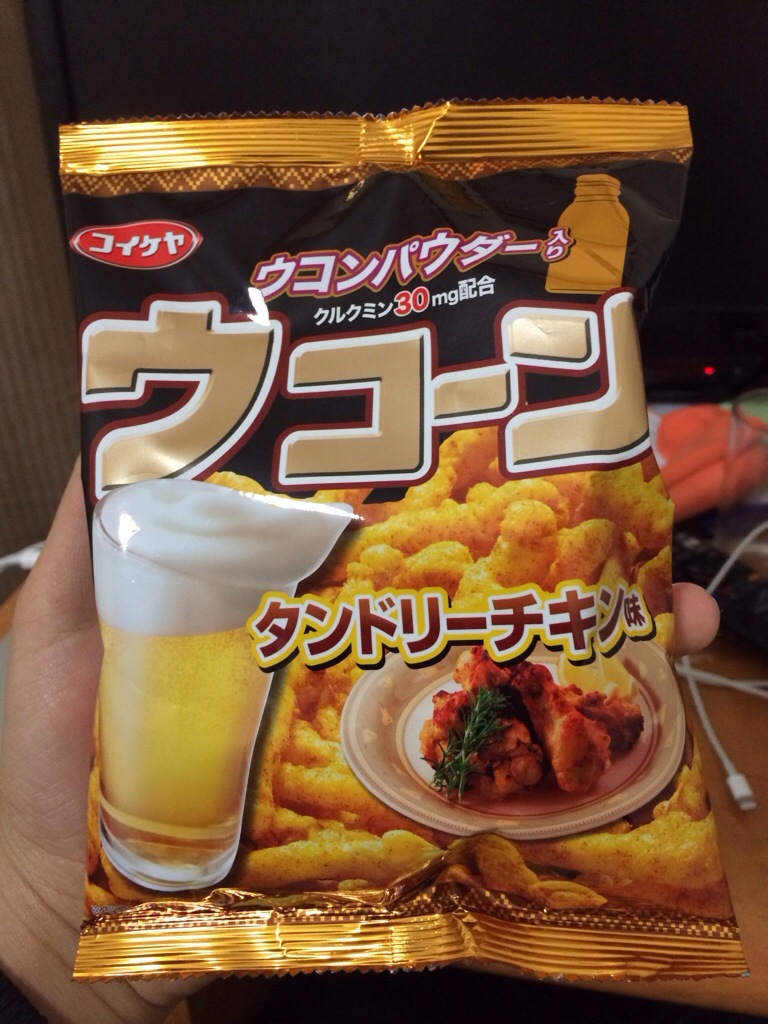
Stephen Eats Weird(ish) Japan: Hangover Cure Tandoori Chicken Corn Snacks

So as I reported earlier, I bought a bag of a peculiar hangover cure-turned-snack-food-concoction from my local conbini (short for convenience store, don’t you know?).  Today, well technically yesterday since it’s currently two in the morning, I finally got around to tasting it.  Anyways, the video of me actively tasting it is as follows:

So after the relative high of the warm and rich Hokkaido Potato Buns, I was met with a resounding meh from the hangover crisps.  They weren’t bad per se but they weren’t all that awesome really, pretty much just weird Cheetos with an aftertaste and not much of the promised tandoori chicken flavor.

Now is this snack effective in warding off alcohol-induced pain? I don’t know… Can plain Cheetos cure a hangover?  If they can, then the answer is probably yes.  If not, well…

Anyways, I’ve got one other food item lined up for Stephen Eats Weird(ish) Food then I’ve either got to start looking for more stuff or simply wait for the next cycle of fresh funky flavors out of the Japanese food conglomerates.  (Japanese convenience stores usually rotate their special flavors of items every month or so but it usually seems like a day.)  If any of you, my faithful readers, have any suggestions for stuff I should eat or questions about Japan in general (“Will Fukushima radiation give you wings?”), hit me up in the comments section here or on youtube or you can reach me on Twitter @STEPHEN TETSU.  Things will only get better if you guys pitch in because I sure as hell don’t have the talent of skills to make this crap any good.

-Stephen

PS Ukon no Chikara is meant to be ingested before the night of drinking so that the turmeric (the main ingredient in the magic elixir) can kick in before the booze wreaks havoc on your insides.  I’m assuming that the situation is the same with the corn snacks as well.

Stephen Eats Weird(ish) Japan: Hokkaido Potato Butter Steamed Buns

Sometimes I see something and plan and plan to try it.  Sometimes things randomly appear in the hot container while you’re waiting in line at the convenience store and you decide on a whim to try it.  Tonight, while waiting in line to buy something that I also intend to test later, I came across a rather interesting choice for the contents of a Chinese-style steamed bun (bao): Hokkaido potato butter.  Hokkaido, for the uninitiated, is the northernmost main island of Japan and known as the bread basket of the nation.  Potatoes are tubers that grow in the ground and are in everything and apparently make you fat.  Butter is the stuff you put on bread.

Anyways, quickly shelling out the 126 yen cost for the little round bread thing, I quickly dashed (okay, I walked) back to my apartment and dug into the surprisingly tasty vegetarian (as far as I could tell) bun.

The potatoes were somewhere in between mashed and cooked, some in a more solid state that others and tasted strongly of pepper and butter.  There were also bits of minced carrots in there and, the theme of this bun being Hokkaido, a couple kernels of corn (Hokkaido cuisine in Japan is usually generalized as being butter and corn in everything).  But the prevailing flavor was the unmistakable starchiness of taters which actually was a good combo with the sweetish bun bread.

So my final verdict on this one is a buy.  Is it mind-glowingly awesome? No.  Is it good for odd convenience store steamed buns?  Yes.  In fact, I think it’s better than the standard Sunkus niku-man (pork bun) that they usually put out there.  So if you happen to find yourself in Japan and in a Sunkus convenience store, go ahead and try the Hokkaido Potato Butter Bun.  There are tons of worse things you could spend your 126 yen on.

-STEPHEN

P.S. Any suggestions, comments, inflammatory comments?  Please share them with me, either here in the comments section, on my youtube channel, or on twitter @STEPHEN_TETSU.  Thanks!

A tandoori chicken flavored hangover cure?

20140211-202956.jpg

Found this in my local convenience store. Ukon no Chikara is a Japanese supplement that supposedly prevents any hangovers if consumed before a night of hard drinking.

What you see here is apparently Ukon no Chikara turned into a Cheetos-type corn snack. Additionally, Japanese snack food rules dictate that it must also be tandoori chicken flavored.

This could be awful

Expect the video taste test up in a few days. Until then, pray this stuff doesn’t kill me.